The 2-person GTM team: a GTM Engineer and a Content Engineer
How a 2-person GTM team does the work of 10 SDRs: what the GTM Engineer does, what the Content Engineer does, where RevOps fits and the tools it runs on.
What used to take 10 SDRs now runs on two people: a GTM Engineer, who takes each account from signal to pipeline, and a Content Engineer, who warms it up before the first message arrives. It works not because they work harder, but because the two roles feed each other: content creates signals that outbound acts on, and outbound reaches people who have already seen your name.
- 01CaptureBoth
- 02EnrichGTM Engineer
- 03DecideGTM Engineer
- 04ActBoth
- 05LearnBoth
Why two people can do the work of an SDR team
Because most of a traditional SDR's work was manual and repeatable: finding accounts, finding contacts, verifying emails, copying data into the CRM, writing the same message with three words changed. A system does that work now, and what is left is designing it, running it and improving it.
An SDR team scales by volume: more people, more accounts touched, more messages. A two-person GTM team scales by judgement: fewer accounts, better chosen, contacted at the moment there is a reason to. The difference is not how many emails go out, but how many reach someone who had a reason to reply.
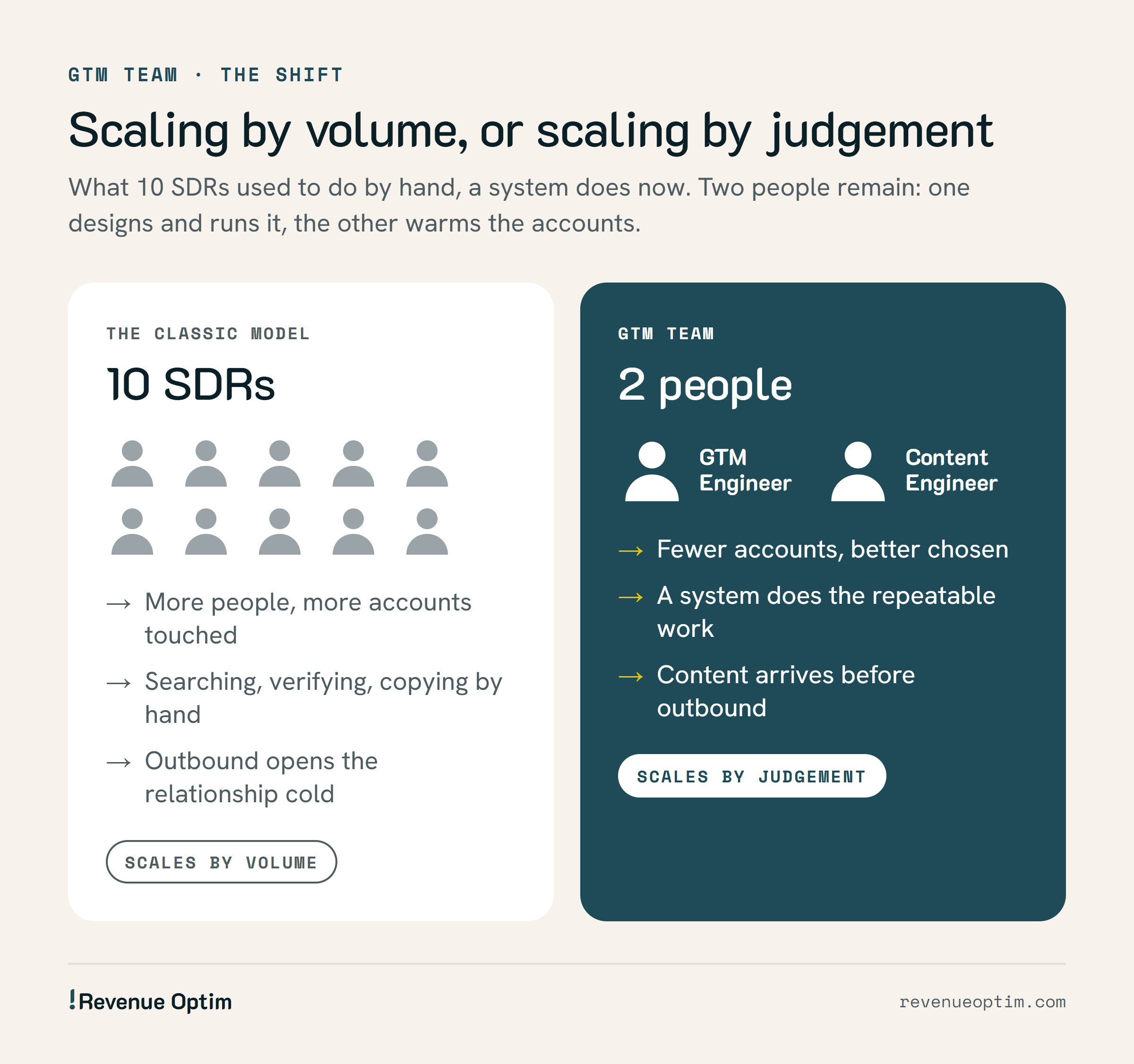
The second change is the order. In the traditional model outbound opens the relationship cold and marketing runs in a separate lane. In this model content arrives first, and outbound comes in once the account has already seen the brand.
What the GTM Engineer does and what the Content Engineer does
The GTM Engineer owns the path from signal to pipeline; the Content Engineer owns the engine that warms accounts before outbound starts. Each one works for the other.
GTM Engineer
From signal to pipeline
- Collects the signals
- Enriches, scores and decides
- Runs the sequences
- Writes everything back to the CRM
Content Engineer
Warms accounts before outbound
- Creates the pieces and the calendar
- Distributes the content
- Talks with the audience
- Passes on who engages, as a signal
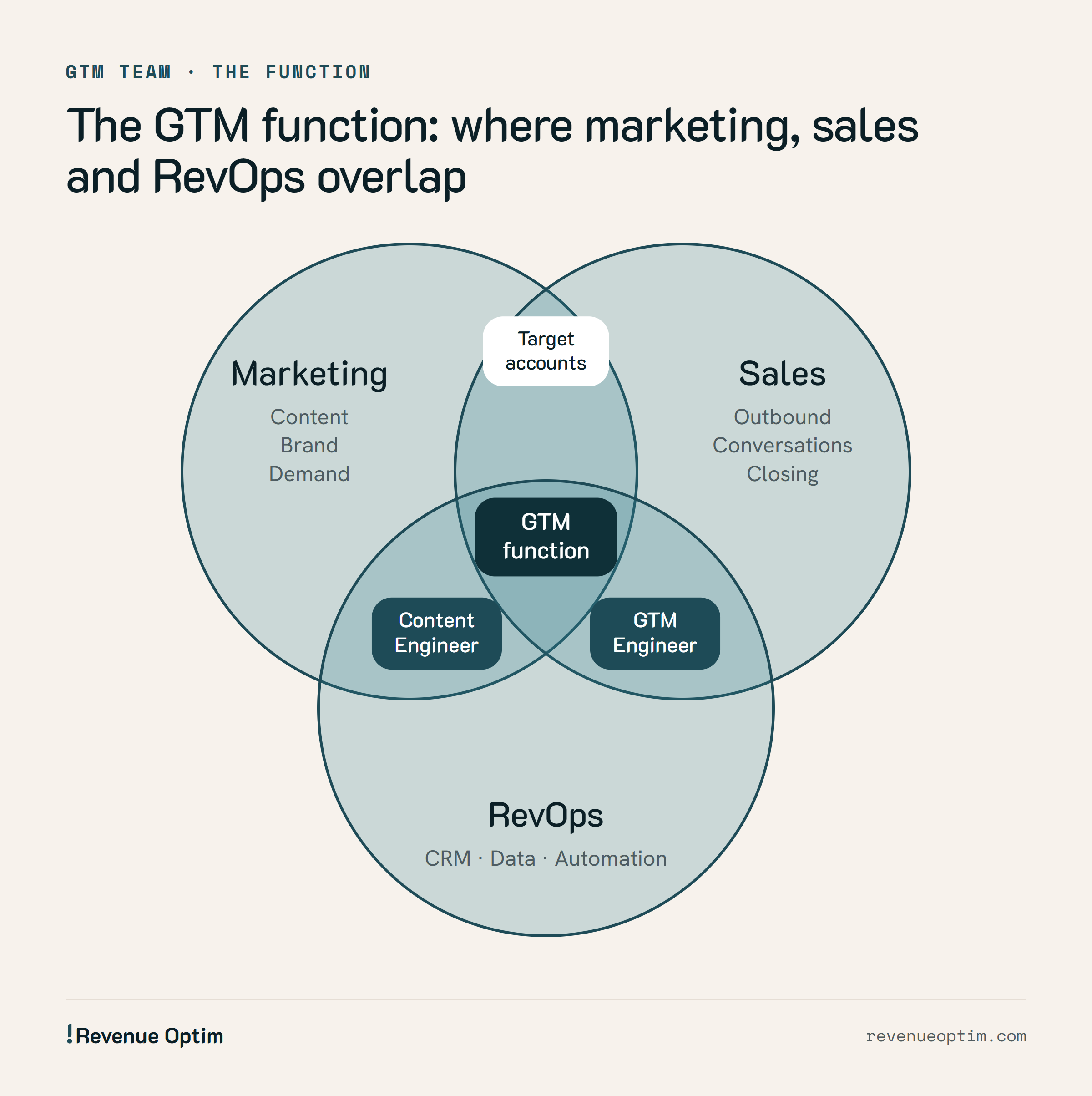
The GTM Engineer builds and runs the machine: where the signals come from, how the data is enriched, how the team decides whom to write to and with what, and how everything gets back into the CRM. It is a technical and commercial profile at once, closer to RevOps than to an SDR. For more on what it builds, see what RevOps is and the GTM tools page.
The Content Engineer makes sure that, when that first message arrives, it is not the first contact. They create the pieces, distribute them, talk with the audience every day and, most importantly, hand back to the GTM Engineer who has engaged: every comment or reaction from a target account is a warm signal.
Where RevOps fits in a two-person GTM team
The two roles do not work on their own: they need someone who owns the CRM, the data and the sales process. That is RevOps. In a small team, the GTM Engineer and the Content Engineer sit under RevOps, leadership sets the target and the ICP, and sales (an AE or, early on, the founder) turns the conversations that reach them with context into customers.
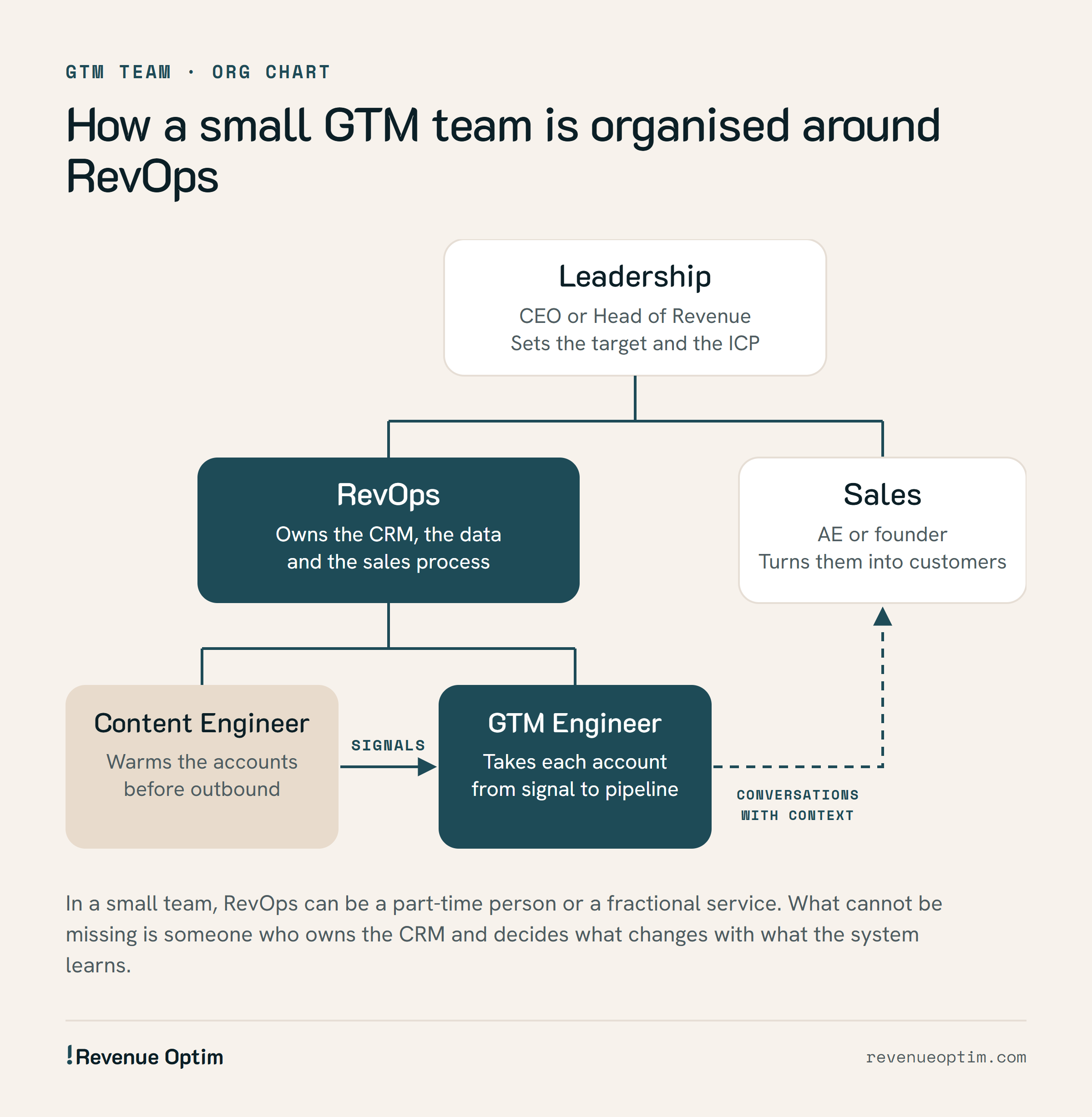
RevOps does not have to be a full-time person. What cannot be missing is someone who decides what changes with what the system learns. If nobody does that today, it is the gap Fractional Revenue Operations fills.
Phase 1: capture signals
Every signal that says an account is on the move lands in one place, so nobody has to hunt for it by hand. It is the only phase both roles feed.
Runs on



Signals come from four sources:
- The CRM itself. Recent activity, lost opportunities that start moving again, customers that grow.
- Intent. Accounts researching your category before they put their hand up.
- Changes in people. A new decision-maker at a target account, someone who moves company and already knew you.
- Content. Who on your account list reacts to, comments on or shares your posts. This is the one the Content Engineer brings.
Size and sector tell you who might buy from you one day. A signal tells you who can buy now. If your ICP is still partially identified and not documented, start there: we explain how in calculating your real ICP.
Phase 2: waterfall enrichment
Before anyone writes, every account and every contact is completed with verified data, drawing on several sources one after another until the gaps are filled.
Runs on



Waterfall enrichment means asking one provider; if it does not have the data, the next one; and so on until it is found or ruled out. That is how you get verified emails, normalised company data and fields a single database would leave empty.
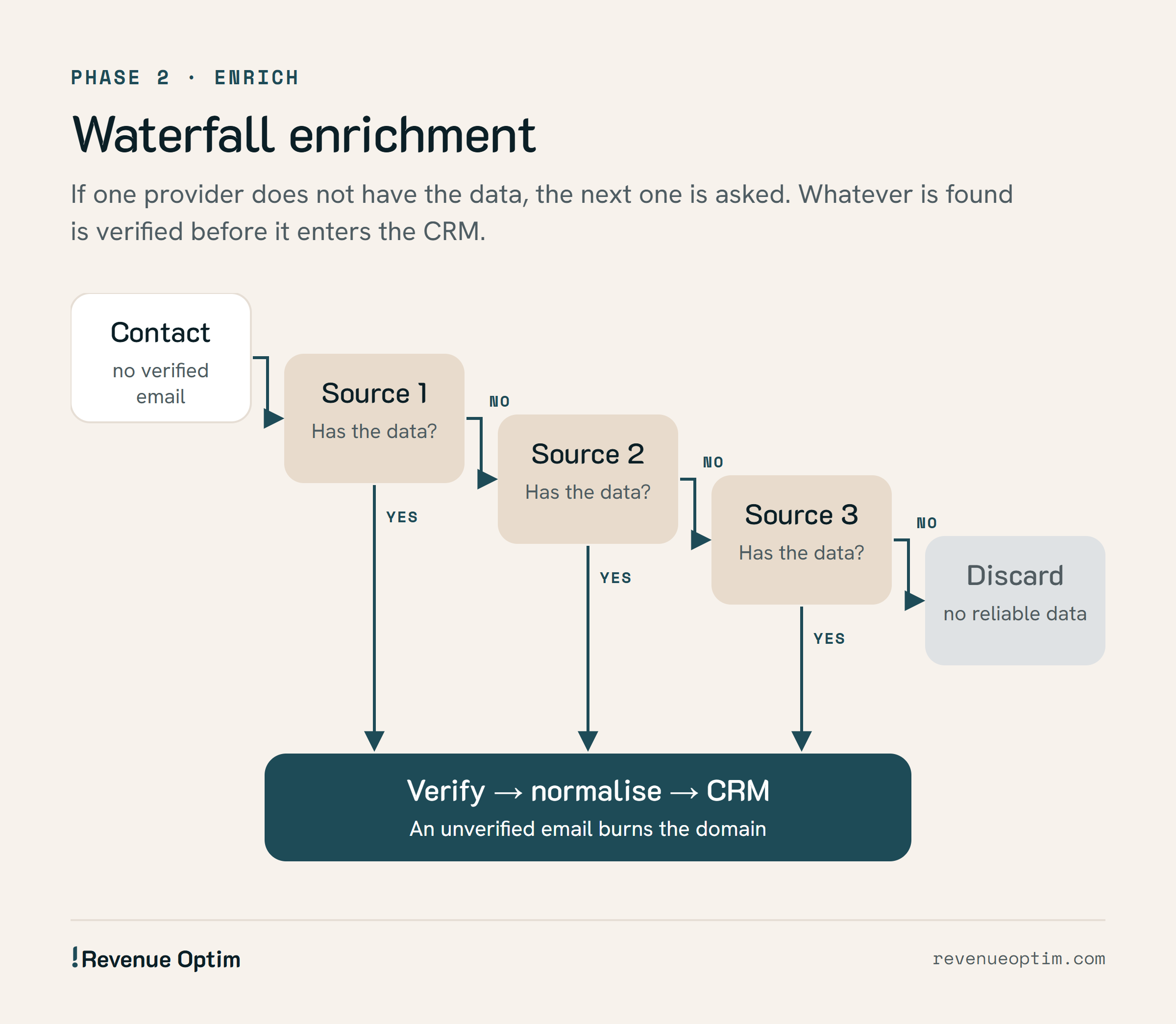
It is the phase that ate the most SDR hours and the one that automates best. It is also the one that does the most damage when done badly: an unverified email burns the domain, and a badly normalised field breaks the segmentation of everything downstream.
Phase 3: decide the next play
With the data complete, every account is scored on ICP fit and on intent, and leaves this phase with a concrete reason to write to it today and the play that applies.
Runs on

AI does two jobs here: classifying accounts against written criteria, and reading the signal to suggest the angle of the message. Automation does the rest: if the account fits and there is a signal, it enters the matching sequence; if it fits but there is no signal, it waits; if it does not fit, it drops out.
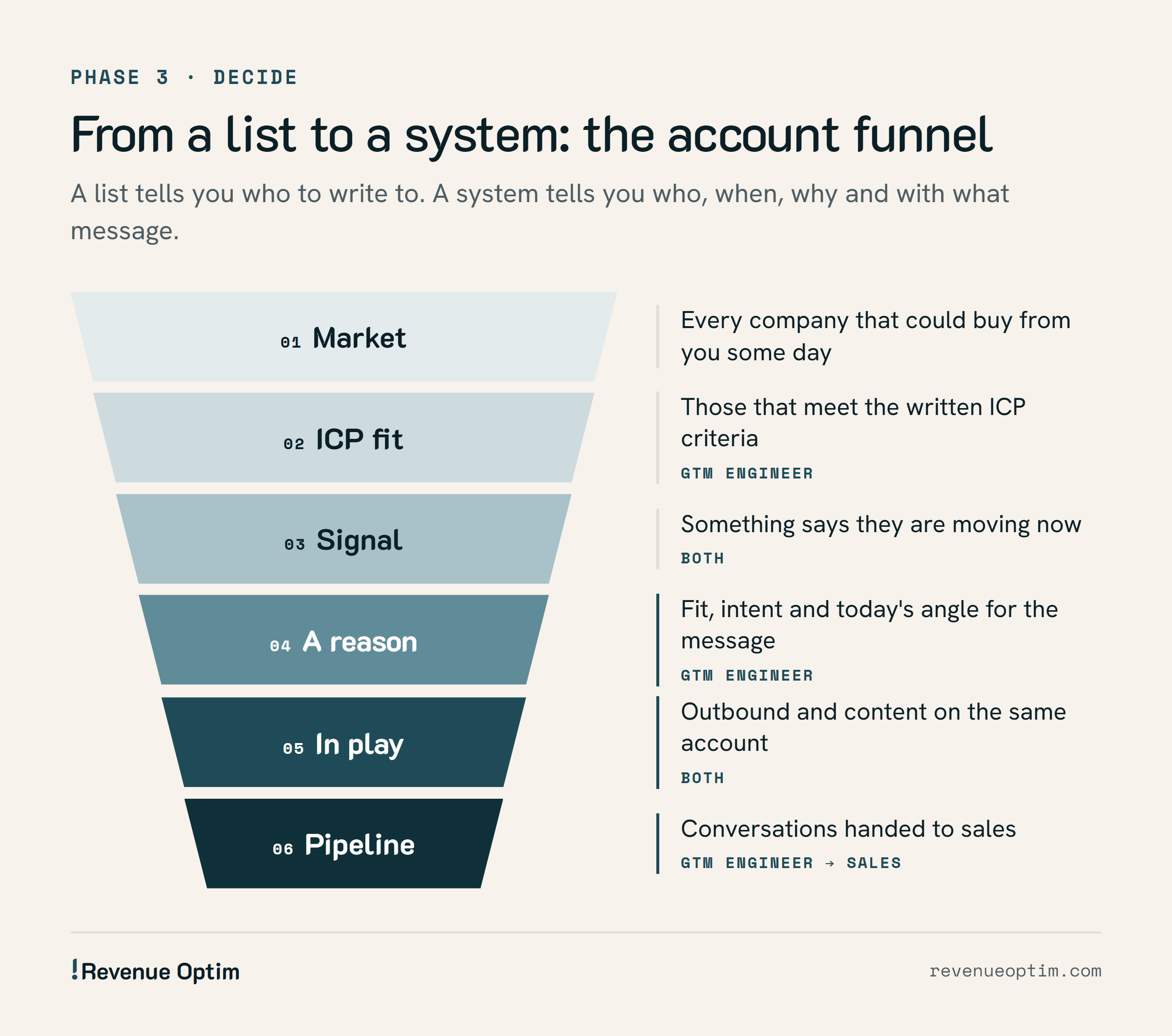
This is the phase that turns a list into a system. A list tells you whom to write to. A system tells you whom, when, why and with what message.
Phase 4: two engines on the same account
Outbound and content work the same accounts at the same time: outbound leads the conversation and content warms it.
Outbound
Email and LinkedIn, every touch with a reason. It leads.


Content
Pieces, distribution and daily conversation. It warms.
The GTM Engineer's outbound combines email and LinkedIn, and every touch has a reason that comes from the signal, not from a template. How that sequence is built is covered in multichannel cadences.
The Content Engineer's content is not a separate campaign: it is made for the same people outbound is about to contact. When the first email lands, the account already knows your name, and that changes how it is read. That is why more people reply, and conversations start a step further on.
Phase 5: learn every week
Every outcome goes back into the CRM with its source, and a weekly review adjusts the ICP, the messages and the signals being watched.
Runs on


Replies, meetings and what is said on calls become data: which signal led to each conversation, which message worked with which profile, which accounts never reply. Without this phase the system does not improve; it only repeats itself.
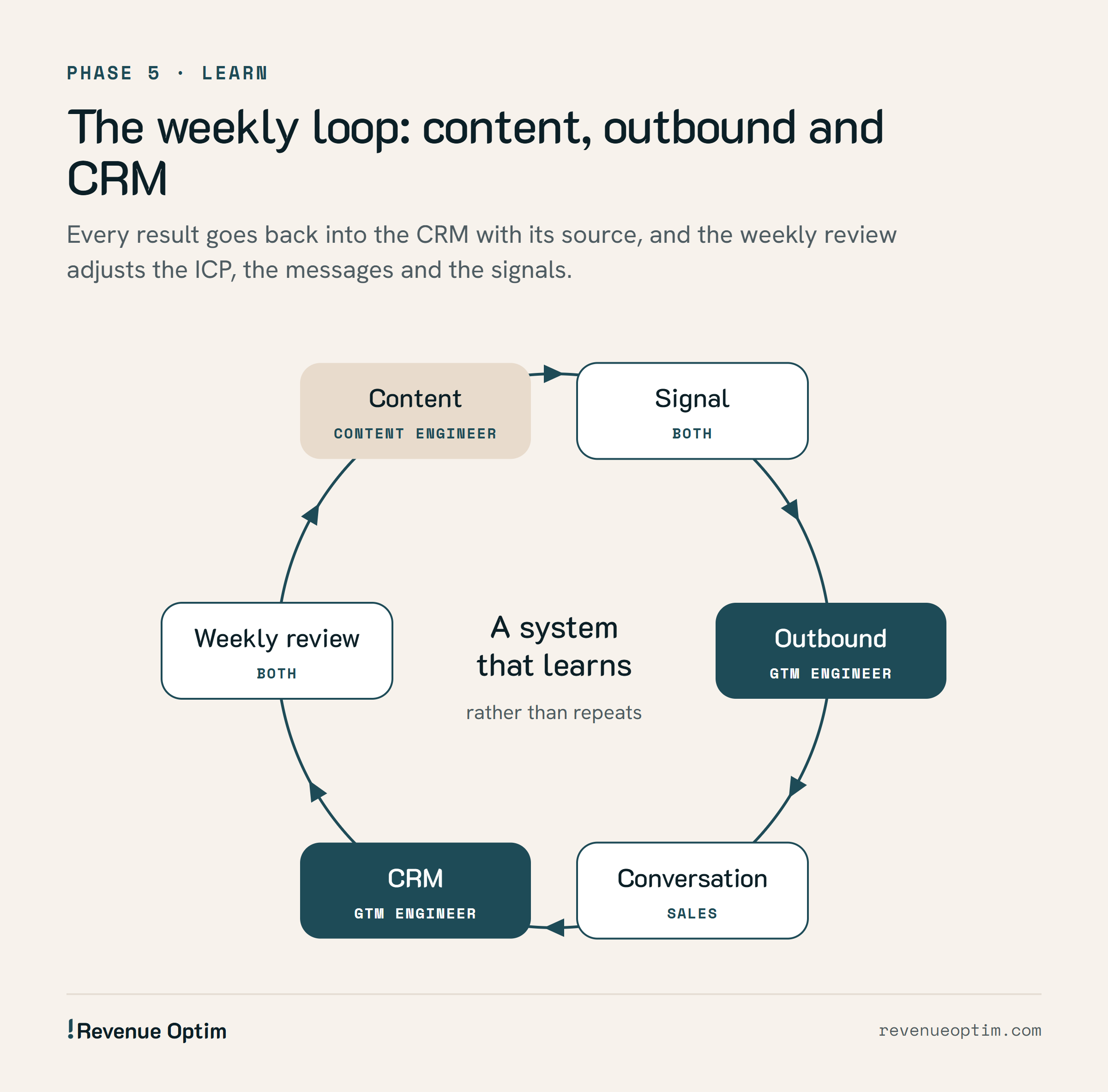
The review is weekly because signals go stale. An account that was researching your category a month ago may already have bought.
What does not change: without an ICP and a reliable CRM, two people automate the mess
This model multiplies what you already have. If the ICP is not written down or the CRM is not reliable, two people with good tools just reach the wrong accounts faster.
Before building the machine, check three things: that the ICP is written with criteria someone else could apply, that the CRM reflects what actually happens in the sales process, and that someone decides what to do with what the system learns. If you have doubts about the second, these are the signs your CRM needs an audit.
How to start if you have neither role
Most B2B teams have neither a GTM Engineer nor a Content Engineer, and they do not need to hire both on day one. There are three routes, depending on where you are:
- If you do not know what is failing, start with the RevOps & GTM Diagnostic: three weeks to confirm what is breaking in your sales process and in what order to fix it.
- If you want the system to be yours and run by your team, the Outbound System designs and builds it in your stack and hands it over to your team.
- If you want someone to run it for you, the first role is what we do as a Fractional GTM Engineer: we build the system in your own stack and run it with you, against a monthly objective we review together.
In all three cases the order is the same as in this article: signals and data first, then the decision, and only then the messages.
Want to go deeper?
Download the RevOps Playbook and get the full framework in writing.