Is context the future of the CRM?
The future of CRM with AI is not in the screen but in the context: a base that adjusts its own fields and turns them into reliable metrics, KPIs and OKRs.
In the SaaS world, choosing a CRM has followed a fairly predictable script for years. Startups began on HubSpot and, as they grew, the unwritten rule was to migrate to Salesforce somewhere around 40 million in ARR. There were alternatives, from Microsoft Dynamics to newcomers like Attio, but that was the script.
And there was something everyone knew: the CRM was a contract for life. Once you were in, the amount of data, fields, automations and reports you had built up made migrating expensive, slow and risky. You changed CRM once at most, and nervously.
That script is running out of time. If an assistant tells you what is pending with each account, you stop opening the CRM. If emails, meetings and calls flow in by themselves, nobody types into it any more. And if AI can read one data model and move it into another, migrating stops being a nightmare. Vendors who keep polishing the screen will be polishing exactly the thing that is going away. The future of CRM is something else: a database that understands what it stores, creates and adjusts its own fields, and turns all of it into the metrics a company is run on. A context-first CRM.
What the CRM was for until now
If you think about it, the CRM has always done three jobs at once. It is the record, the place that says which accounts you have, who owns each one and what has been signed. It is the rep's workplace, with their tasks, their notes and their next step. And it is where Monday's report and the forecast leadership looks at come from.
Vendors have fought their war almost entirely over the second job: which screen is nicer, which automations come out of the box, which report you can build without calling anyone. And that is exactly where the reps' eternal complaint lived, which is a fair one: the CRM asks a lot of you and gives little back.
What AI takes away from the CRM
AI takes two of those three jobs away from the CRM, or at least moves them somewhere else.
The first is the screen. If I can ask an assistant what is pending with an account and it answers with everything joined up, why would I open the CRM? The day's work becomes a conversation, and whatever screens are needed will be generated on the spot, shaped around whoever is asking.
The second is data entry. Emails, meetings, calls, product usage and support tickets can already reach the CRM without anyone typing them. What used to depend on the rep being disciplined now depends on someone having connected things properly.
What is left is the record: a few tables with accounts, contacts, opportunities and activities. A database, basically. And that is exactly where the trouble starts.
Why a database is not enough
A database tells you what happened. An agent, to really help you, needs to know why it happened and what it means. It is easier to see with an example.
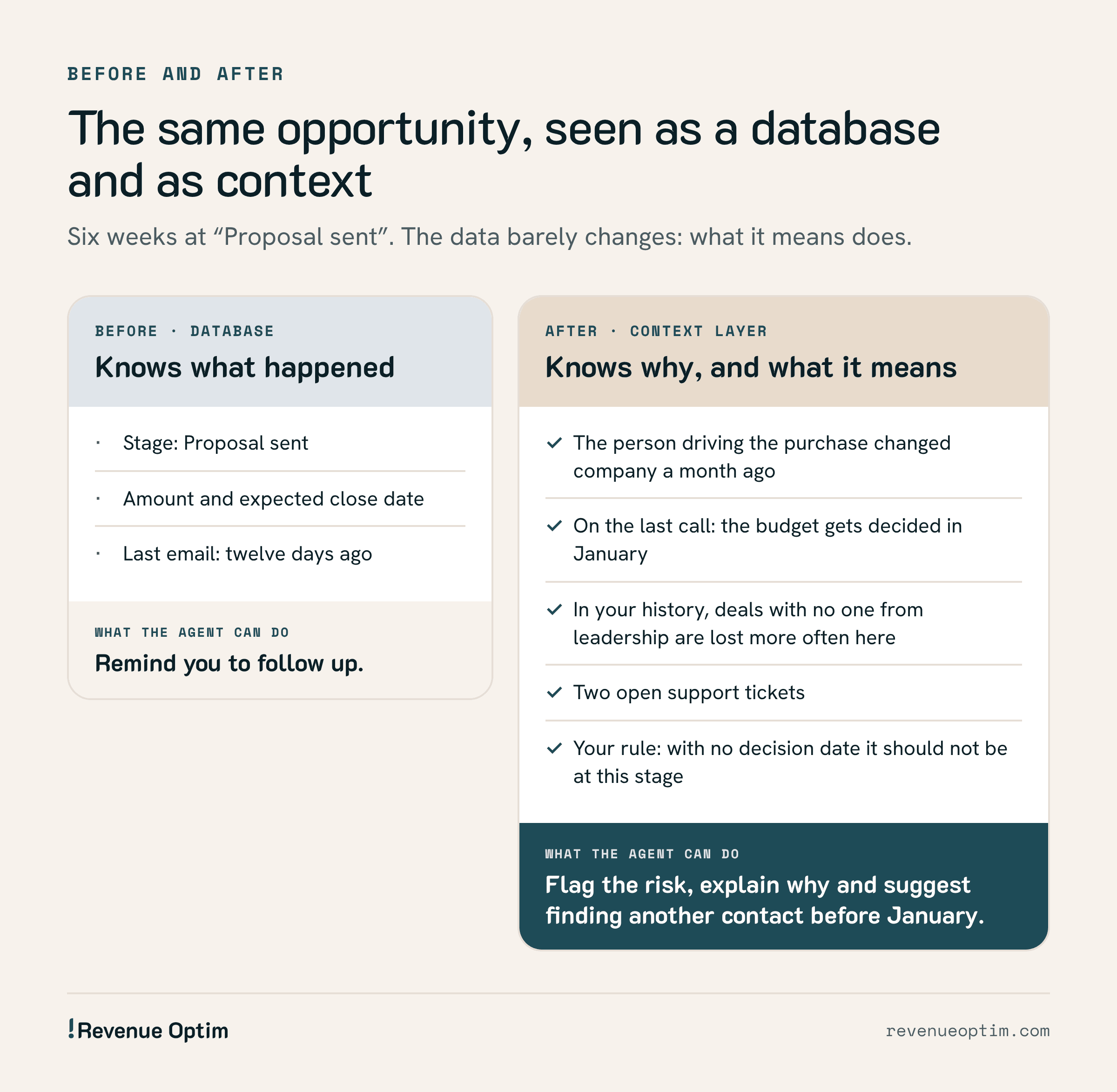
Picture an opportunity that has been sitting at "Proposal sent" for six weeks. The database knows that, the amount, the expected close date and that the last email went out twelve days ago. With that, the most an agent can do is remind you to follow up. Thanks, you knew that already.
Now imagine the system knows a bit more. That the person pushing the purchase left for another company a month ago. That on the last call the customer said the budget gets decided in January. That in your history, opportunities with nobody from leadership involved tend to die at exactly this stage. That the account has two open support tickets. And that, by your own rule, a proposal with no agreed decision date should not even be at this stage.
With that, the agent can tell you something useful: this opportunity is at risk, for these reasons, and the sensible move is to find another contact before January. Notice that we have barely added any data. What we have added is meaning, and that is the whole difference between a database and a context layer.
What the CRM of the future will look like: context-first
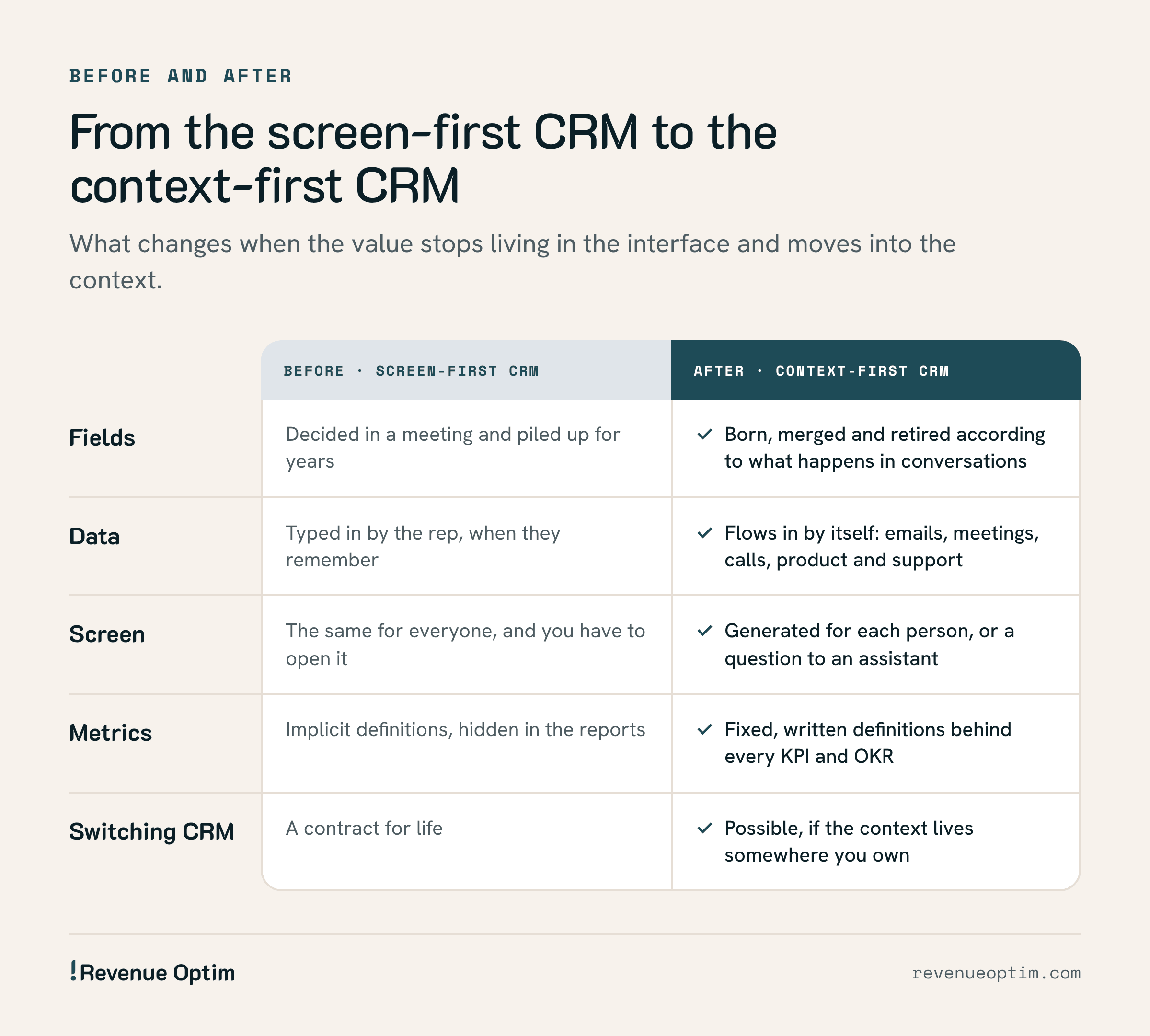
Today a CRM's fields are decided in a meeting. Someone asks for a new one, someone else creates it, and three years later there are four hundred, half of them empty and a few meaning the same thing under different names. The data model stays frozen in what someone imagined one day, while the business keeps changing.
A context-first CRM turns that around. The data model stops being a fixed structure and becomes something alive, adapting to what actually happens in conversations with customers. Imagine a CRM that does things like these:
It notices that the same security objection has come up again and again on calls in recent weeks, proposes a field to capture it and fills it in backwards by reading the transcripts it already has. It realises that "Sector" and "Industry" are the same data point written two ways and suggests merging them. It tells you that a field nobody has touched in a year can be retired. And, looking at the history, it tells you that one of your stage criteria predicts nothing, because the opportunities that meet it close at the same rate as the ones that don't.
On top of that base, the screen stops being a product. Each person sees what they need, generated for them: a sales director sees the forecast with its risks explained, a rep sees the day's accounts with the reason for each, and someone in customer success sees which customers are showing signs of leaving. The same base, told three ways.
This is not ten years away. The pieces, from models that read transcripts to assistants that query several tools at once, exist already. What is missing is a CRM designed around them, instead of one that adds them as one more button.
What has to sit underneath
Guille already pointed at it in GTM engineering 2.0 is here: whoever holds the context decides what every other system does. It is not magic, and it is not a product you buy. Underneath a context-first CRM there are five things anyone who has worked in RevOps will recognise.
The first is one record per account. It sounds obvious, but it is common for the same company to exist three times, in the CRM, in billing and in support, each with a slightly different name.
The second is keeping the history, not just the latest value. Knowing an opportunity is in negotiation is not much use if you don't know when it got there or how many times it has gone backwards.
The third is written definitions: what a qualified lead is, what has to happen to change stage, which account fits the ICP. If that is not written down somewhere an agent can read it, every agent will make up its own version, and none of them will be yours.
The fourth is the why: loss reasons, objections, decisions and the reasons behind them. It is what makes learning possible, and it is what almost every CRM we see stores worst.
And the fifth is being clear about which system wins when two disagree, and what an agent can touch without asking.
What doesn't change: data that becomes metrics, stories, KPIs and OKRs
Here is the risk in everything above. A CRM that creates and edits its own fields can be wonderful, or it can be the fastest way to rot your data. If fields change by themselves, the KPI you watched in March may not measure the same thing in September, and nobody will have noticed.
That is why the base does not change. In the end, a CRM exists so that data becomes metrics, metrics become KPIs and KPIs become the OKRs a company is run on. What does change is that, with context, the CRM can also tell the story behind the number: not just that proposal-to-close conversion has dropped, but that it has dropped in the accounts where the contact changed, and since when.
A context-first CRM, done well, has two layers that behave differently. One adapts by itself: the fields that capture what happens in conversations, which can be born, merged and retired. The other only changes when someone decides it should: the definitions behind every metric, every KPI and every OKR. The first gives you flexibility. The second gives you trust. Without the second, the first is noise.
What about judgement? It can be captured too, on conditions
Some people will say that activity captures itself but judgement does not. I don't think that is entirely true any more.
With meeting-notes tools like Granola, which we use on our own discovery calls, what a team discusses no longer gets lost. When the sales team sits down to review why a deal was lost or whether an account is worth it, that conversation is transcribed and summarised. If there is then an orderly workflow that takes the conclusion to the right record in the CRM, the why gets into the system without anyone filling in a field. Not long ago, that depended on someone taking good notes and then actually bothering to put them in the CRM.
That said, four things have to happen for it to work, and the tool does none of them. There has to be a meeting, because if nobody reviews lost opportunities there is nothing to transcribe. The meeting has to end in a decision, because a transcript keeps the three opinions that came up and the CRM needs the conclusion. Someone has to have designed the workflow: what gets pulled out of each meeting, which record it goes to and what happens if it contradicts what was already there. And whatever is decided has to end up as a rule. If the team agrees on a Tuesday that a proposal with no decision date does not count as a proposal, that has to become a stage criterion, not get lost in that Tuesday's notes.
In other words, judgement can reach the CRM almost by itself, but the path it travels has to be built. That is why I don't think AI takes work away from RevOps. It changes it: less chasing reps to fill in fields, more designing meetings, workflows, definitions and rules. In a context-first CRM, RevOps looks after the layer that must not change by itself. And if marketing and sales have not yet agreed on the basics, the first step is a marketing and sales SLA.
From a contract for life to context you own
If migrating is no longer so frightening, does the contract for life end? Not entirely. It moves.
Until now, what tied you to the CRM was volume: years of records, hundreds of fields and automations nobody dared touch. With AI, moving records and matching fields from one system to another is increasingly machine work. What does not move so easily is context: the definitions, the history, the why behind each decision and the rules behind each metric. If all of that lives only inside the CRM, in the vendor's format, the contract for life comes back, stronger than before.
So the useful question is no longer just which CRM to choose. It is where your context lives and whether it is yours. The definitions of your stages, your ICP and your KPIs should be written down somewhere you control and can take to any system. That is the insurance that lets you change CRM when it suits you, not when the vendor lets you.
What happens to HubSpot, Salesforce and the other CRMs
For anyone selling a CRM, all this raises an awkward question: if the value is no longer in the screen, where is it? I see three ways out and, honestly, I don't know which will win.
The established CRMs may reinvent themselves as context-first. The big ones are already adding assistants and connections for agents, and if they manage to make their data model come alive, they will stay at the centre. The CRM may stay as a database, with context built in another layer on top that reads from the CRM and from everything else. Or CRMs may appear that are born context-first, designed from scratch to be used by agents rather than people.
What I am sure of is what I would tell a company choosing a CRM today: don't choose by the screen. Ask other questions. Whether it is easy to get data in and out. Whether it keeps the history of changes or only the latest value. Whether you can store definitions and reasons with structure, rather than in a free-text field. Whether you can connect agents with clear permissions. Whether, when the system changes a field, it records who changed it and why. And whether, the day you want to leave, you can take not just the records but the context too. Those answers will matter more than the demo.
What you can do with your CRM this quarter
There is no need to wait and see who wins. Almost everything that gets a CRM ready to be context-first can be started now, with the CRM you have:
- Write one sentence per stage saying what has to be true to move to the next one.
- Make the loss reason mandatory, picked from a closed list. Nobody can analyse free text afterwards.
- Remove duplicates and decide which system wins for each data point.
- Take stock of your fields: which ones are used, which mean the same thing and which can go.
- Hang everything you know about an account from the same record: emails, meetings, calls, product and support.
- Make sure the CRM keeps when each stage changed and who changed it.
- Write down the definition of every metric you watch, every KPI and every OKR, and which fields it uses, somewhere that is yours and does not depend on the CRM. If your ICP is partially identified and not documented, start by calculating your real ICP.
- Set a fixed meeting to review what was won and lost, record it and define how its conclusions reach the CRM.
If you are not sure what state your CRM is in, go through the signs it needs an audit. And if you would rather we look at it together, that is what the RevOps and GTM Diagnostic is for: we review the commercial process and the system behind it, and tell you where to start. The work itself is done by our CRM, data and forecasting projects.
Frequently asked questions
What is the future of CRM?
Context. With AI, the screen loses value and data flows in by itself, so the CRM that matters will be the one that understands what it stores: with its history, its definitions and its why, and able to turn it into reliable metrics, KPIs and OKRs. That is what we call a context-first CRM.
What is a context-first CRM?
It is a CRM designed around context rather than the screen. Its data model adapts to what happens in conversations with customers, creating, merging and retiring fields, while keeping fixed the definitions behind every metric. The screen is generated on top, shaped around whoever uses it.
Is the CRM going to disappear?
No. What loses weight is the screen. The record is still needed, and with agents working on top of it, it matters even more, because nobody will spot at a glance that a data point is wrong.
If fields create themselves, how do I know my KPIs still measure the same thing?
By separating two layers. The fields that capture what happens can change by themselves. The definitions of your metrics, KPIs and OKRs only change when someone decides they should, and every change is recorded. Without that separation, a CRM that adapts by itself ends up being a CRM nobody trusts.
If data captures itself, why do you need RevOps?
Because someone has to build the path and look after what must not change. Tools like Granola capture what the team talks about, but someone decides which meetings happen, what gets pulled out of them, where it goes and when a conclusion becomes a rule. That work does not disappear; it grows.
Will it be easier to change CRM?
Moving records and fields, yes: it is increasingly machine work. What will still tie you down is context, if it lives only inside the CRM. If your definitions, your history and your rules are written down somewhere of your own, the CRM stops being a contract for life.
Do I have to change CRM to get ready?
Almost never as a first step. Stages, loss reasons, unified accounts, a field inventory and the definitions of your metrics can all be worked on in the CRM you already have. If you need to switch later, at least you will know what you are looking for.
Want to go deeper?
Download the RevOps Playbook and get the full framework in writing.